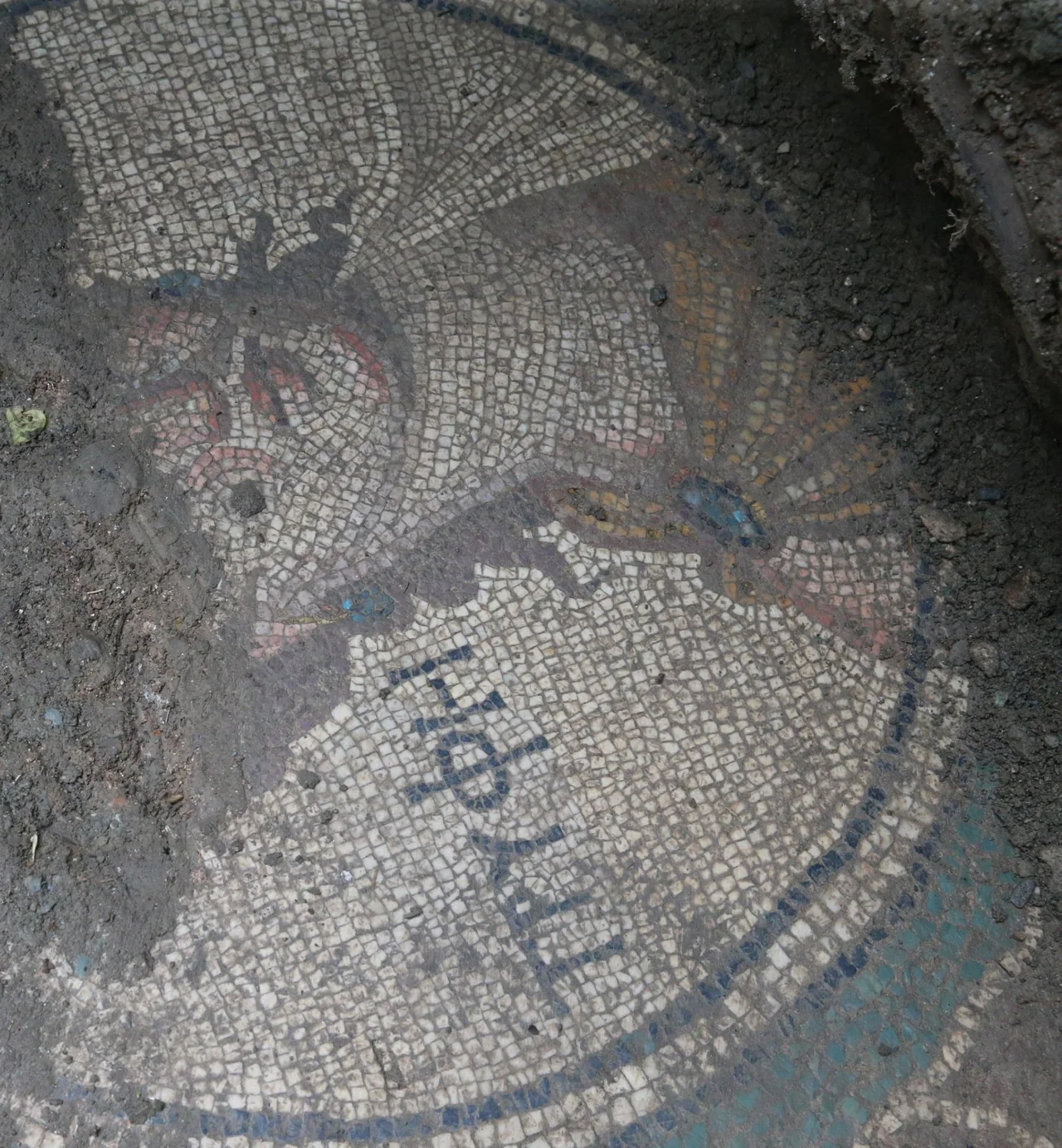
A figured Roman mosaic discovered in Zile, in Türkiye’s Tokat province, in 2025 bears the inscription ΤΡΥΦΗ. Transliterated as Tryphe, the Ancient Greek word encompasses ease, refinement and luxury. Archaeologist Alper Yılmaz identifies the accompanying female figure as a personification of that idea. The floor would therefore have offered the people using the room more than an image: it presented a desirable way of life.1,2,3
In the first photograph, the lettering catches the eye. Its dark colour stands out against the pale ground and the coloured pieces around it. Each letter, apparently a continuous line from a distance, resolves into individually set fragments at closer range. Before reaching the meaning of the word, we encounter the workmanship that makes it legible.4
What does Tryphe mean?
Tryphe has no single English equivalent. The Liddell–Scott–Jones lexicon ranges from softness and refinement to luxurious living. Depending on its setting, the word can express an admired elegance or a disapproved excess. “Abundance and plenty”, often used in reports of the Zile find, captures only part of that range. The idea concerns the pleasure and comfort of living, as well as the possession of plentiful things.3
Ancient artists could give such ideas a human form. Life appeared as Bios; foundation or generous patronage as Ktisis; luxurious ease as Tryphe. In this device, known as personification, an inscription helps identify what the image represents. The five letters at Zile name the idea embodied by the figure.2,5,6
Tryphe was also used as a personal name in antiquity: a gravestone in the Princeton University Art Museum commemorates a woman of that name. At Zile, the reading depends on the word’s use in comparable mosaics and on specialist assessment. The available evidence does not identify the figure as a portrait of a particular woman named Tryphe.7,2
Colour, line and individual pieces
The small pieces making up a mosaic are called tesserae; a single piece is a tessera. Their colour and orientation build a letter’s outline, a figure’s curve or the pattern of a border. Continuing regular rows across a field calls for different decisions from modelling the shadow of a face. Repetition and finely judged variation can occupy the same floor.8
Both scales can be seen in the early photograph from Zile: the pale field around the inscription and the red, pink and ochre fragments of the figure. Only part of the pavement is visible. Although the face and pose cannot be made out fully in this view, the lettering, the panel’s edge and the direction of the tesserae reward a closer look.4
A Roman pavement, its date under study
In remarks published on 5 May 2026, Alper Yılmaz described the use of opus tessellatum alongside opus vermiculatum. The latter denotes fine work in small tesserae that can follow a contour closely. On stylistic grounds, he proposed the second century AD. This is an attributed assessment of the find, made by a named specialist at a known date.2
Style is one part of archaeological dating. The deposits below a pavement, its adjoining walls, repairs and associated objects also contribute to the history of a building. Detailed excavation evidence will allow the proposed date at Zile to be considered alongside those findings. For now, the work can be described as Roman, with the second-century proposal explicitly attributed to Yılmaz.9,10
How a room presented itself
Putting an image of luxurious ease on a floor raises a question about the tastes of those who commissioned it. In prosperous Roman households, pictures, fine tableware, furniture and pavements worked together to make an impression. A guest was entertained in an environment shaped by the host’s choices. In such a setting, Tryphe could express prosperity, refinement or an aspiration to live well.8,11,12
We do not know the names of the people who used this floor in Zile, and the building’s function remains unsettled. The inscription nevertheless preserves an idea placed in their surroundings. Tryphe appears with other personifications at Olba and shares a couch with Life on a panel said to come from Emesa. At Zile, she belongs to a Roman pavement in inland Anatolia. The find adds a local expression to this shared visual language.13,14,15
Notes
- 1DHA (opens in a new tab). Tokat’ta izinsiz kazıda Antik Yunanca yazı bulundu · Demirören News Agency (DHA). source record ↩
- 2DHA (opens in a new tab). Tokat’ta ‘Çingene Kızı’ benzeri mozaik gün yüzüne çıktı · Demirören News Agency (DHA). source record abcd
- 3LSJ, τρυφή (opens in a new tab). τρυφή · A Greek–English Lexicon. source record ab
- 4Daily Sabah · AA photo (opens in a new tab). Historic mosaic unearthed in Zile reveals Türkiye’s ancient past · Daily Sabah · photograph: Anadolu Agency (AA), 7 May 2025. source record ab
- 5Ünsal and Şahin 2023 (opens in a new tab), pp. 378–381. Tryphe ve Bios Mozaiği’nin İkonografik ve İkonolojik Açıdan Değerlendirilmesi · Journal of Mosaic Research 16 (2023), pp. 377–387 · DOI 10.26658/jmr.1376865. source record ↩
- 6The Met 1998.69; 1999.99 (opens in a new tab). Fragment of a Floor Mosaic with a Personification of Ktisis · Inventory 1998.69; 1999.99. source record ↩
- 7Princeton y1992-48 (opens in a new tab). Gravestone of Tryphe · Inventory y1992-48. source record ↩
- 8Kondoleon 2016 (opens in a new tab). Introduction · Alexis Belis, Roman Mosaics in the J. Paul Getty Museum (2016). source record ab
- 9Tekin et al. 2024 (opens in a new tab). 2022 Yılı Zile Kalesi Antik Tiyatrosu Arkeolojik Kazı Çalışmaları · 43rd Excavation Results Meeting (Kazı Sonuçları Toplantısı), vol. 6 (2024), pp. 151–160. source record ↩
- 10Alberti, Bourguignon and Roby 2013 (opens in a new tab). Technician Training for the Maintenance of In Situ Mosaics · Getty Conservation Institute · Institut National du Patrimoine. source record ↩
- 11Raff 2011 (opens in a new tab). The Roman Banquet · The Metropolitan Museum of Art. source record ↩
- 12Ünsal and Şahin 2023 (opens in a new tab). Tryphe ve Bios Mozaiği’nin İkonografik ve İkonolojik Açıdan Değerlendirilmesi · Journal of Mosaic Research 16 (2023), pp. 377–387 · DOI 10.26658/jmr.1376865. source record ↩
- 13Erten 2016 (opens in a new tab). Olba 2015 Kazılarından Yeni Bir Buluntu: Roma Mozaiği · Seleucia 6 (2016), pp. 61–91. source record ↩
- 14Royal Ontario Museum 967.132 (opens in a new tab). Wall mosaic with allegorical representation of Life and Easy Living · Inventory 967.132. source record ↩
- 15İHA (opens in a new tab). İkinci Zeugma Tokat’ta gün yüzüne çıkartılıyor · İhlas News Agency (İHA) · agency copy published on Adana Masası. source record ↩